
Francis Halzen awarded physics Nobel for Antarctic neutrino detector
The Belgian physicist proposed IceCube in 1988. Completed in 2011, the observatory uses a cubic kilometre of ice to detect particles from space.
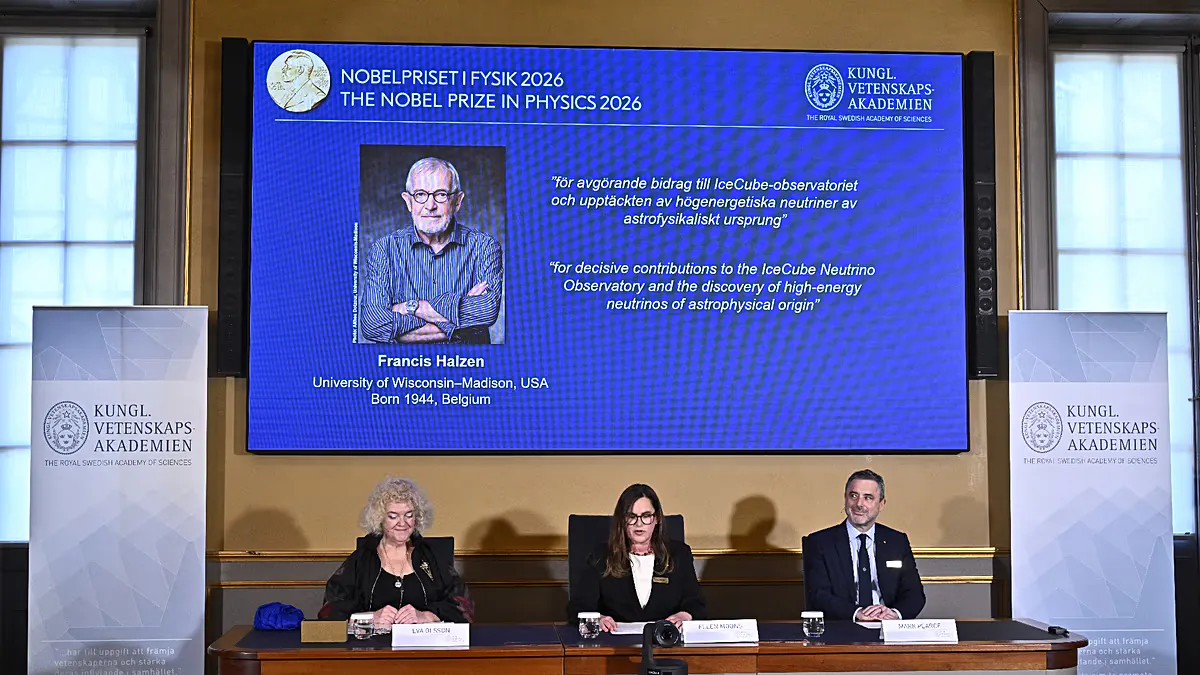
The 2026 physics Nobel has been awarded to Belgian scientist Francis Halzen, recognising his work on the IceCube Neutrino Observatory. The prize jury cited his contribution to the detector and the discovery of neutrinos with high energies coming from astrophysical sources.
At Antarctica's Amundsen-Scott South Pole Station, IceCube detects the particles using sensors embedded in a cubic kilometre of ice. The Royal Swedish Academy of Sciences said Halzen had been instrumental in developing the observatory, opening another way to study the universe.
The academy explained that neutrinos cross space without losing energy or altering their direction, carrying information that cannot be obtained otherwise. The jury said the scarcity of cosmic neutrinos at extremely high energies makes a large volume of ice necessary to record enough collisions.
Halzen put forward his proposal in 1988; early testing began several years later, before construction finished in 2011. He has served as IceCube's principal investigator.
Now 82, Halzen was born in Tienen and has US citizenship. He teaches at the University of Wisconsin–Madison and directs its Institute for Elementary Particle Physics. Joining the Stockholm announcement by telephone from Italy, he expressed surprise and said he hoped the honour would reflect on those who joined the project early on.