Archaeologists find adolescent skeleton in unusual position in Bavaria
The remains date back around 7,000 years. Further examination will investigate a deformation of the neck vertebrae and the body's position in the grave.
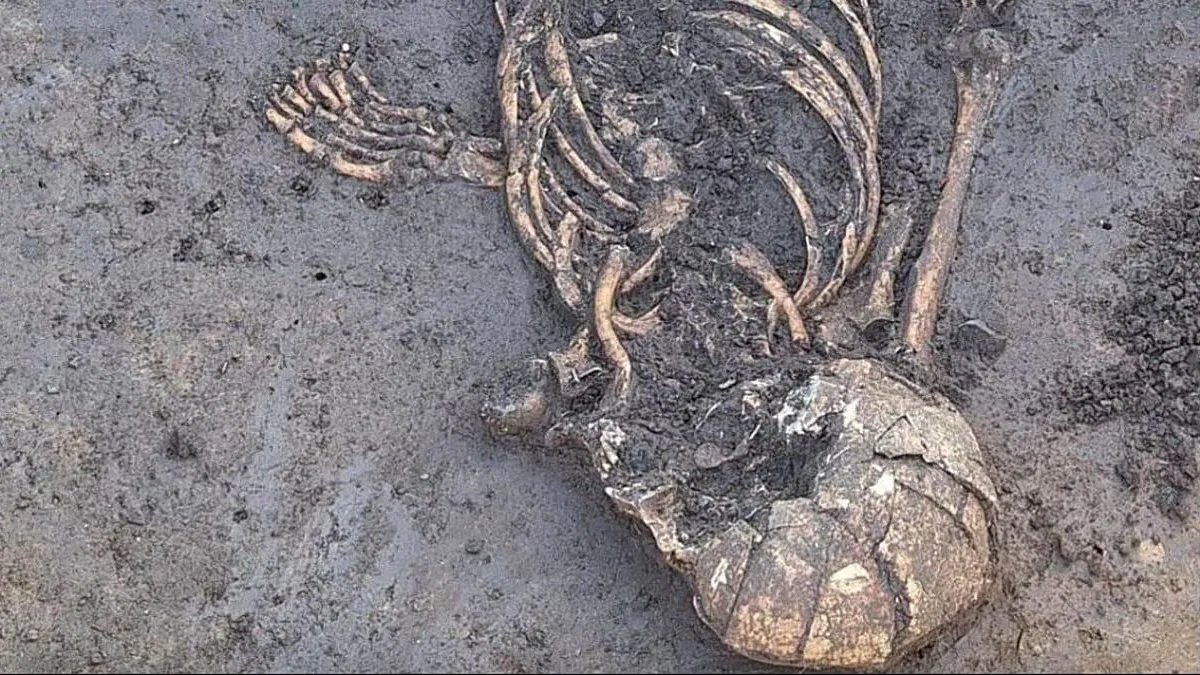
Archaeologists excavating a planned development site in Großköllnbach, in Bavaria's Dingolfing-Landau district, have recovered the skeleton of an adolescent who lived around 7,000 years ago. The arrangement of the limbs differs from customary burials of the period, while a pronounced deformation of the neck vertebrae requires further investigation.
District archaeologist Dr Florian Eibl said people of the Linear Pottery culture commonly placed the dead on their sides with their knees drawn towards the body. This skeleton instead had a sharply bent right leg and a left leg pointing outwards. Eibl suggested that the grave's sloping, uneven bottom may have allowed the body to slide, moving some bones or pushing them into soft clay.
Growth plates that had not fully fused indicate that the person was an adolescent. Researchers have yet to establish whether the neck deformation reflects illness, a physical characteristic during life or changes after death. The recovered bones are now at the district archaeology department for anthropological examination.
Investigators recorded around 150 features during five weeks at the future Steigäcker IV development area. These include traces of three large longhouses, although no more than two are thought likely to have existed simultaneously, as well as hearths, cooking areas and domed clay ovens with pebble-insulated floors.
Archaeologists also found grinding slabs whose stone may have originated beyond the Danube or in the Bavarian Forest. The excavation is closed to visitors. The district archaeology service plans to share additional findings after the scientific work is complete.