Germany and Japan agree closer cooperation on economic security
Friedrich Merz and Sanae Takaichi set out plans for supply-chain monitoring, rare earth diversification and a high-level dialogue on artificial intelligence.
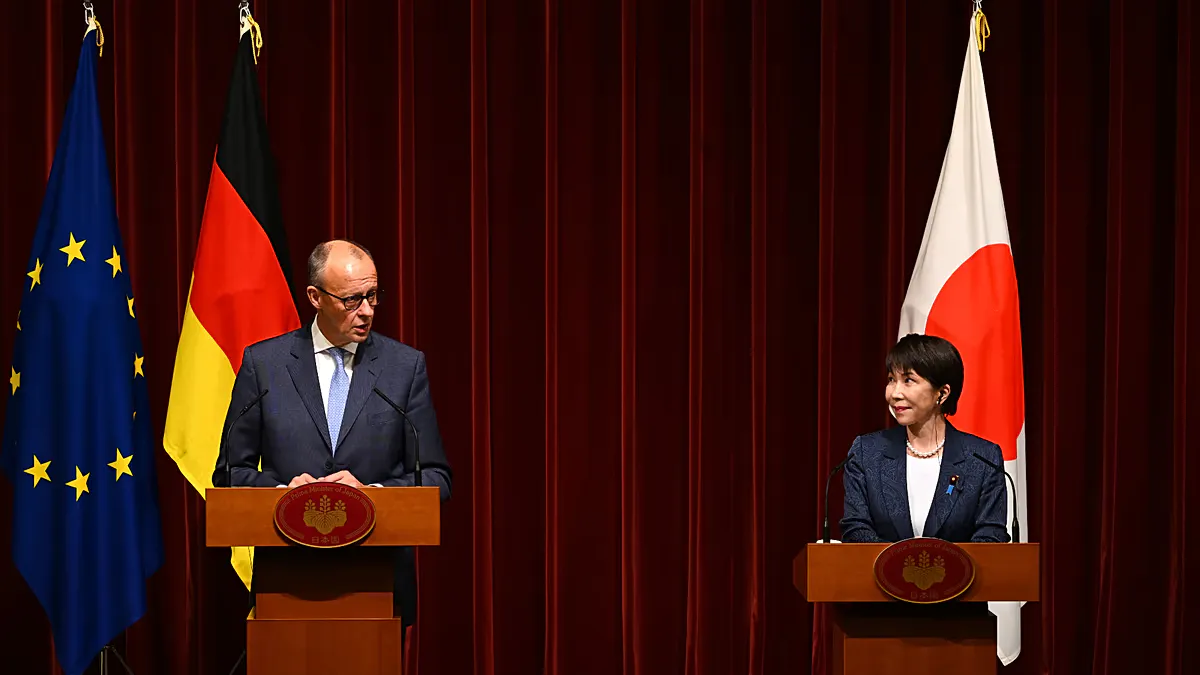
German Chancellor Friedrich Merz and Japanese Prime Minister Sanae Takaichi have agreed to deepen cooperation on economic security and advanced technologies during Merz’s first visit to Japan. Their joint statements set out intentions to coordinate more closely on supply chains and examine partnerships across key industries.
The leaders expressed concern about economic coercion, including export curbs and retaliatory action involving critical raw materials. They also opposed practices that distort markets or create excess capacity. Neither China nor the United States was named in the statements or their subsequent remarks.
Germany and Japan intend to increase joint monitoring and assessment of supply chains to guard against economic dependencies being used to exert pressure. Areas under consideration for closer collaboration include pharmaceuticals, wind power, robotics, industrial AI, batteries, semiconductors and electric cars.
Merz and Takaichi welcomed a signed declaration of intent covering critical raw materials. They also outlined plans to diversify rare earth supplies and improve the scope for replacing those materials in both countries’ automotive industries. Separately, they agreed on a high-level AI dialogue and closer cooperation against cyberattacks.
Speaking at an economic forum in Tokyo, Merz called for a political alliance to support international rules governing trade and coordinate responses when those rules face threats. Germany plans to invest €2 billion in AI and high-tech by 2029, while Japan is targeting around €18 billion in private investment in those fields by 2040.