Ireland seeks €141 billion cut to proposed EU long-term budget
Agriculture and cohesion would face smaller reductions than competitiveness and external cooperation under the Irish presidency’s compromise.
The Irish presidency of the EU has presented a compromise for the bloc’s 2028–2034 budget totalling €1,622 billion at 2025 prices. That would remove €141 billion from the European Commission’s proposal, a reduction of 8 per cent, while leaving spending 30 per cent higher than under the current long-term budget.
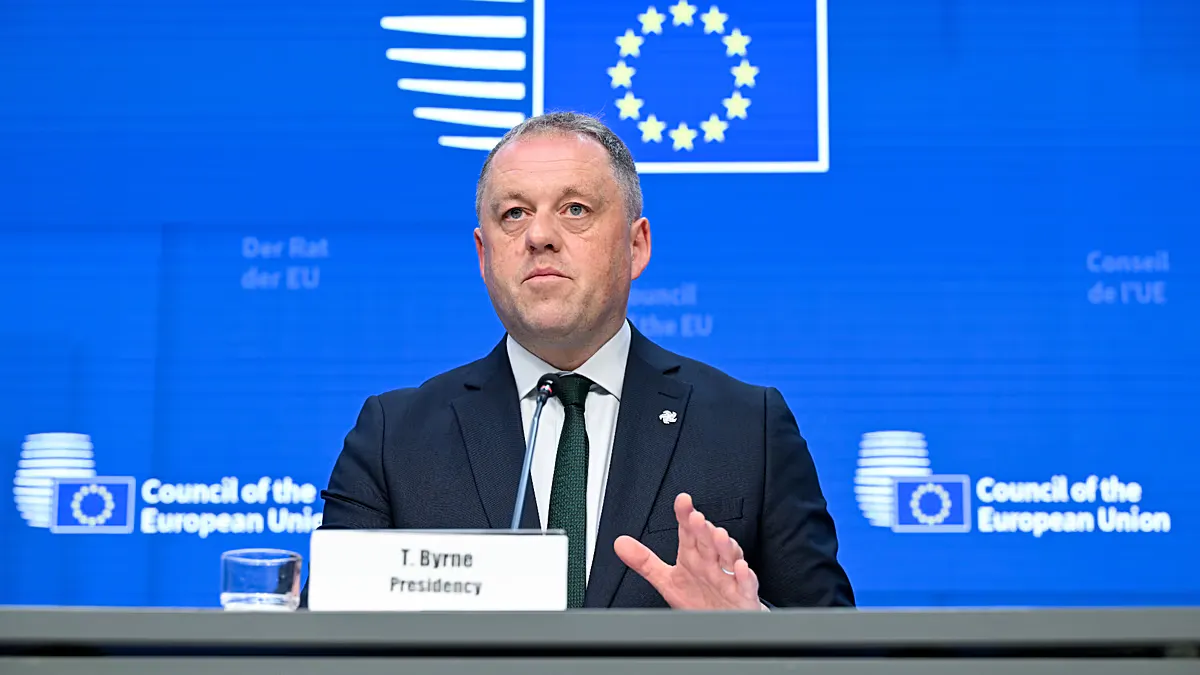
Ireland’s Minister of State for European Affairs, Thomas Byrne, said the plan balanced funding for competitiveness and defence with support for agriculture and cohesion, while taking account of member states’ fiscal constraints.
- Cohesion, agriculture and fisheries would receive €914 billion after a 3 per cent cut.
- Competitiveness, research and defence funding would fall by 13 per cent to €456 billion.
- Administration spending would decline by 8.8 per cent to €95 billion.
- Global Europe, supporting cooperation projects outside the EU, would receive €157 billion, down 17 per cent.
The compromise also sets out EU revenue measures estimated to raise €55 billion a year. Ireland wants a 90 per cent call rate for the Carbon Border Adjustment Mechanism, rather than the Commission’s proposed 75 per cent. The mechanism covers carbon-intensive imports.
Proposed levies on tobacco, corporations and electronic waste remain in the package, as does EU retention of 90 per cent of customs duties. However, the European Parliament’s suggested taxes on digital services, online gambling and crypto assets are excluded.
Germany leads six countries pressing for deeper cuts. Italy’s Giorgia Meloni heads the 17-member Friends of Cohesion front, which prioritises farmers and poorer regions. Sweden’s Minister for EU Affairs, Jessica Rosencrantz, criticised the proposed total as unaffordable and said agreement was still distant.
Negotiators are seeking a political agreement before the year ends. The General Affairs Council will consider the proposal on 13 October, ahead of discussions among leaders at the European Council on 15–16 October.